


Here's something I hear pretty regularly from Florida homeowners: "My property taxes can't go up more than 3% a year because I have a homestead exemption." I've also heard people say that taxes on rental properties and second homes can't increase more than 10% annually.
Both statements are based on real Florida laws. But there's a pretty important misunderstanding: Florida's caps limit increases in your property's assessed value, not your entire property tax bill. And that distinction can make a much bigger difference than you might expect.
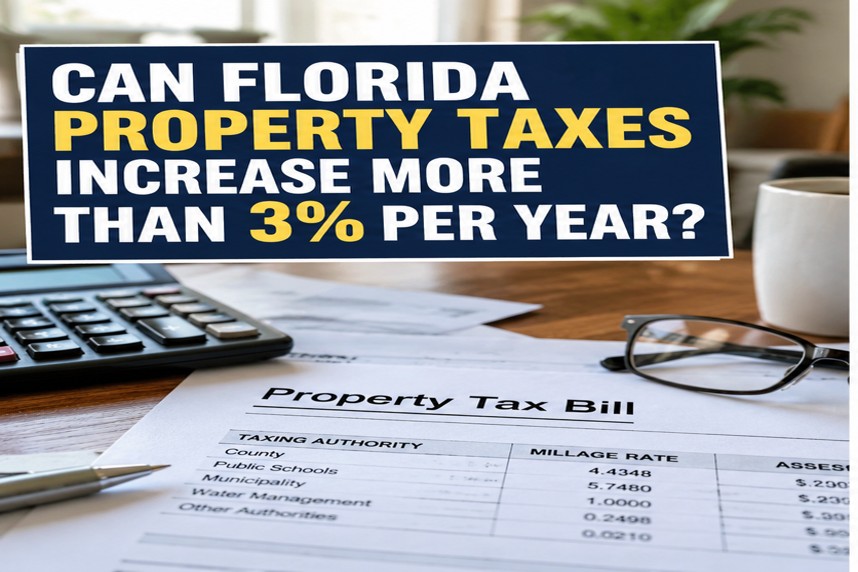
What is Florida's 3% property tax cap?
Florida's Save Our Homes law protects qualifying homesteaded properties. After the benefit begins, the assessed value generally cannot increase by more than 3% or the increase in the Consumer Price Index (CPI), whichever is lower. For 2026, the applicable Save Our Homes cap is 2.7%.
Let's say your home's assessed value was $250,000 last year. At 2.7%, the maximum increase would generally be $6,750, taking the assessed value to $256,750. Your home's market value could have increased much more, but Save Our Homes limits the increase in the assessed value used for taxation. That's a terrific benefit for longtime owners.
Assessed value is not the same as your tax bill
Your actual bill depends on more than the property appraiser's assessment. There are two major types of charges:
- Ad valorem taxes are based on taxable value and millage rates set by taxing authorities, which can include the county, school district, city and other districts. A mill is $1 of tax per $1,000 of taxable value.
- Non-ad valorem assessments generally aren't based on property value. Depending on the location, these can cover services such as solid waste, stormwater or fire protection.
Save Our Homes doesn't cap millage rates or non-ad valorem assessments. Those can change even when the assessed value is protected.
How could a tax bill rise 12% with a 2.7% assessment cap?
Here's a deliberately simplified illustration. Assume a home's taxable value is $200,000, the combined millage rate is 15 mills, and non-ad valorem assessments total $500. The ad valorem tax is $3,000, making the total bill $3,500.
Now imagine that the taxable value rises 2.7% to $205,400, the millage rate rises to 16 mills, and non-ad valorem assessments increase to $650. The ad valorem tax becomes $3,286.40, for a total bill of $3,936.40. That's about 12.5% higher than the year before.
The assessment cap wasn't necessarily violated. The millage rate and assessments changed.
Important: This example assumes the taxable value increases at the same rate as assessed value solely to make the arithmetic easy to follow. Florida's legal cap applies to assessed value, not taxable value. Actual taxable values can differ among taxing authorities because of exemptions.
What about the 10% cap for rental homes and second homes?
Florida generally limits annual assessed-value increases for qualifying non-homesteaded properties to 10%. This can include rental properties, second homes and other eligible real estate. But there is an important exception: the 10% assessment limitation does not apply to school district taxes. And, just like the homestead cap, it does not prevent changes to millage rates or non-ad valorem assessments.
So the statement "My rental property's taxes can't increase more than 10%" is not correct.
Can assessed value increase while market value falls?
Surprisingly, yes. A longtime homesteaded property's assessed value may be well below its market value. If market value falls a little but remains above assessed value, the assessed value can still increase within the Save Our Homes limit. You may hear this described as recapture. Market value and assessed value simply do not always move together.
How do you find out what changed?
If your property tax bill went up more than expected, compare last year's bill with this year's. Check the assessed value, exemptions, taxable values, individual millage rates and non-ad valorem assessments. Your county property appraiser handles valuations and exemptions; the tax collector handles tax bills and collections. Both have useful online records in Pasco, Hillsborough, Hernando and Pinellas counties.
One more thing: if you're buying a home, the current owner's taxes can be especially misleading because the assessment generally resets after a change of ownership. I explain that in a separate article: Buying a Florida Home? Don't Assume You'll Pay the Seller's Property Taxes.
The bottom line
Florida's 3% and 10% limits are assessment caps, not tax-bill caps. They provide meaningful protection, but the total bill can still rise more than those percentages. Knowing the difference makes it much easier to understand your annual tax notice instead of wondering whether someone made a mistake.
Sources: Florida Department of Revenue property tax resources; Florida Statutes section 193.155; section 193.1554; section 193.1555.